You’ve navigated the financials, the tech stack, and the team. But have you validated whether customers actually want to buy?
In private equity, the difference between a good investment and a great one often comes down to a single question: Can this company execute its go-to-market strategy? Yet in most deal processes, GTM receives a fraction of the diligence attention given to financials, product, or market size.
The result? Sponsors enter deals with significant GTM blind spots that only become apparent 6-12 months into ownership – when growth stalls, churn accelerates, or competitive threats emerge faster than anticipated.
The GTM Intelligence Gap
Traditional due diligence relies heavily on management presentations and third-party market research. While these inputs provide a directional view, they often miss the most critical signal: what buyers actually think, say, and do.
Consider a recent scenario. A PE investor was evaluating a high growth software company with impressive reported metrics – robust ARR growth, high gross retention, and a large, expanding TAM. The management team articulated a clear competitive moat based on deep product integration and regulatory compliance features.
Two weeks before closing, we conducted 20 buyer interviews as part of an extended due diligence process. What emerged was starkly different from the management narrative.
Buyers saw the product as “comparable to 2-3 other vendors” – differentiation was illusory. Growth looked strong on paper, but the majority of new customers came from a single channel partnership that was up for renegotiation, creating dangerous dependency. The impressive headline retention masked a troubling reality, customers on legacy contracts stayed, while new cohorts were churning at 25% annually. And the TAM assumptions? They were constrained by integration complexity that management had significantly underestimated.
Armed with these insights, the company renegotiated valuation, restructured management incentives around retention, and immediately prioritized product differentiation and channel diversification in the 100-day plan, turning a potential value trap into a strong outcome.
Why Traditional DD Misses GTM Risks
We see three structural reasons why GTM risks slip through standard due diligence:
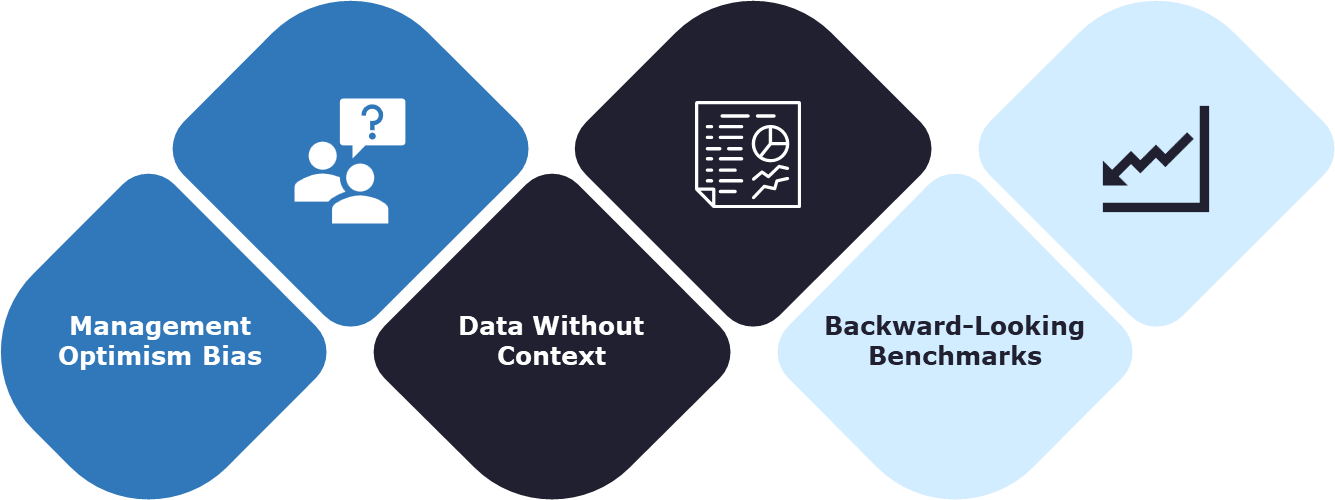
Management Optimism Bias: Management teams are inherently optimistic about their competitive position, TAM and customer sentiment. Sales teams report what they hear from prospects and executives synthesize patterns from limited data. The buyers who chose competitors, the customers who churned and the skeptical prospects who went dark don’t make it into the management presentation.
Data Without Context: CRM systems, when used well, are great at providing quantitative metrics like pipeline coverage, win rates and sales cycle lengths. But they don’t explain why deals are won or lost. A 30% win rate might be excellent or terrible depending on competitive dynamics, pricing strategy and deal qualification rigor. Similarly, an NRR of 110% could signal strong product-market fit or aggressive upselling that erodes customer relationships over time. Without direct market validation, the numbers tell an incomplete story.
Backward-Looking Benchmarks: Third-party research is valuable for understanding historical dynamics, but GTM is fundamentally a forward-looking exercise. What buyers valued 12 months ago may not drive decisions today. Competitive threats emerge quickly and buyer behavior shifts as markets mature. Traditional research can’t answer the question that matters most, “Will this GTM strategy work for the next 3 years?”
The GTM Intelligence Framework
At Clear Go-To-Market, we’ve developed a buyer-validated approach to GTM due diligence and value creation that aligns sponsors and operators around a single set of facts. Our methodology spans the entire investment cycle, from initial due diligence through to exit.
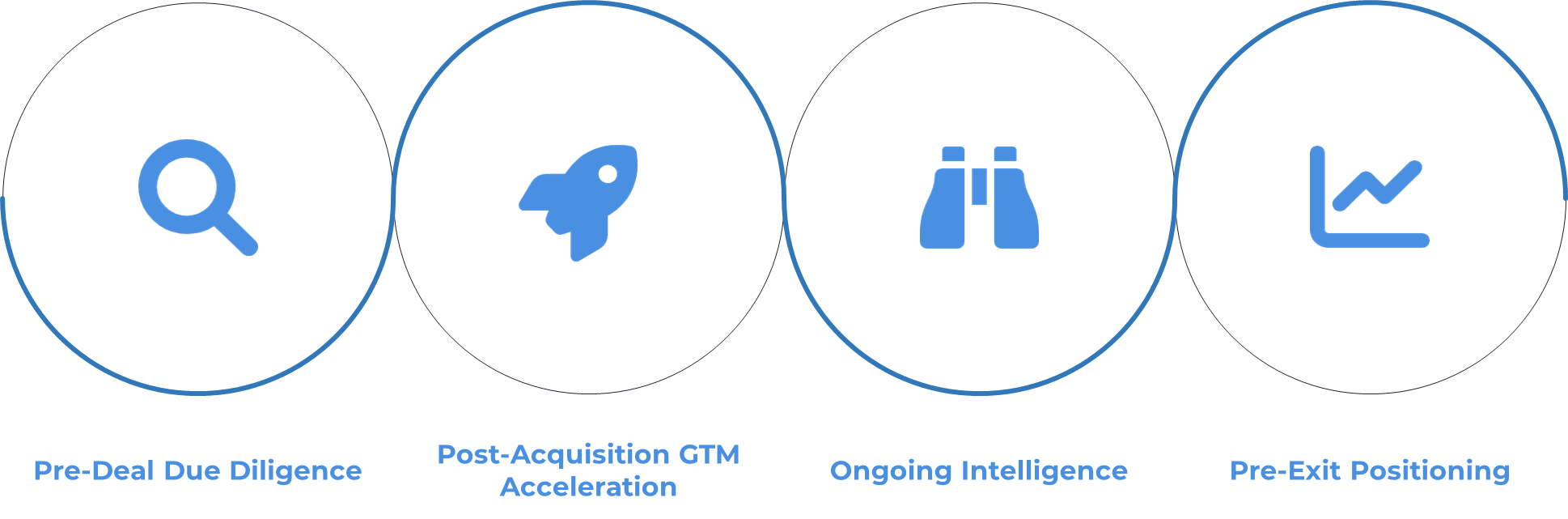
Pre-Deal Due Diligence
Before you close, we validate the growth assumptions and GTM execution risks that will determine whether your investment thesis holds. Through structured buyer interviews and competitive analysis, we assess market sizing, revenue potential, customer sentiment, and deal risk. Through direct market validation, we surface the gaps between management narrative and buyer reality, providing you with clear conviction on what you’re buying and where the execution risks lie.
Key deliverables: Market sizing and growth validation, competitive benchmarking, revenue potential assessment, assessment of customer acquisition and retention
Post-Acquisition GTM Acceleration
In the critical first 100 days and throughout the hold period, we identify the highest-impact levers for revenue uplift and operational improvement. This deep-dive diagnostic translates buyer insights into execution-ready value creation plans, covering pricing optimization, sales productivity, organizational design, and go-to-market strategy refinement.
Key deliverables: 100-day GTM diagnostic, revenue strategy roadmap, pricing strategy and optimization, organizational design, GTM systems and tooling review
Ongoing Intelligence
Ultimately markets don’t stand still, and neither should your GTM strategy. Through continuous monitoring including win/loss pulse surveys, competitive landscape tracking, and quarterly strategic reviews, we ensure management and sponsors maintain visibility on GTM performance, emerging risks, and evolving opportunities. Think of it as an early warning system combined with a performance dashboard.
Key deliverables: Market monitoring, quarterly reviews, win-loss analysis, competitive intelligence
Pre-Exit Positioning
As you prepare for exit, we help you crystallize a compelling, evidence-backed GTM equity story that anticipates buyer scrutiny and maximizes valuation. We validate GTM narrative, assess competitive moat, and provide the analytics that support your target multiple. Strategic buyers and financial buyers ask different questions, we help you prepare for both.
Key deliverables: GTM narrative validation, buyer perspective assessment, competitive moat analysis, valuation support
The Business Case for GTM Intelligence
The ROI on buyer-validated GTM intelligence is significant across three key dimensions – de-risking entry, accelerating value creation and strengthening exit positioning.
Companies that enter with GTM clarity execute faster. Management teams align around a shared set of market facts rather than competing narratives. Boards deploy resources with conviction. And the compounding benefit through the hold period is significant – systematic buyer feedback informs product roadmap and pricing decisions, while demonstrated GTM excellence (e.g. high net retention, efficient CAC payback) commands a multiple premium at exit.
For PE firms and investors looking to systemize GTM intelligence, we therefore recommend:
- Starting Early: Commission GTM diligence in parallel with traditional DD, not sequentially. Buyer interviews take 2-4 weeks, and insights compound when integrated with financial and operational diligence. Waiting until late in the process means discovering risks when you have a limited ability to act on them.
- Go Deep on Risk Factors: If growth is the investment thesis, validate it from the buyer’s perspective. If retention is strong, understand why and whether it’s sustainable as the customer base evolves. If competitive dynamics are shifting, map them in real time rather than relying on six month old analyst reports.
- Align Sponsor and Management: Use GTM intelligence to build shared conviction between sponsors and operators. The best outcomes occur when everyone interprets the same set of facts, not when they’re negotiating whose narrative is ‘right’. This alignment accelerates decision making through the hold period.
- Plan for Value Creation: GTM diligence shouldn’t end at close. The insights you gather inform the 100 day plan, ongoing intelligence programs, and pre-exit positioning. Think of it as building a systematic GTM capability that compounds value over the entire hold period.
In an environment where growth at all costs is out of favor, GTM execution separates winners from losers. PE firms that invest in GTM intelligence enter deals with conviction, execute value creation plans with precision, and exit with demonstrated GTM excellence that commands premium valuations.
The firms that don't? They rely on management optimism, hope the growth story holds, and discover GTM risks when it's too late to de-risk them.
The question isn’t whether GTM risk exits, but whether it’s understood early enough to shape the outcome.
Ready to Build GTM Intelligence Into Your Deal Process?
Schedule a consultation with us to learn more about how we help investors validate growth assumptions, de-risk GTM execution, and accelerate value creation through buyer-validated intelligence.