
There is a particular kind of confidence that haunts boardrooms. It is the confidence of a leadership team that has read the same internal reports for the past three years, validated their assumptions with each other, and mistaken consensus for clarity. They know their market, or at least they believe they do. Then a competitor steals a key customer, win rates quietly decline, and the post-mortem reveals a gap nobody saw coming — the company had been selling to its own idea of its customers rather than to the customers themselves.
The Intelligence Illusion
Operators today have access to more data than at any point in business history. CRM pipelines, product telemetry, market research platforms, AI-generated competitive summaries. The dashboards are full. Yet a striking number of commercial leaders still make their most important strategic decisions based on assumptions that have never been externally tested.
The problem is not a lack of information. It is a lack of buyer truth.
Internal data tells you what happened. It does not tell you why customers chose you, or why they chose someone else. It does not surface the decision criteria your sales team never heard because the conversation never got that far. It does not reveal how buyers actually perceive your positioning versus a competitor's, or whether the value proposition your product team spent six months refining is landing the way you intended.
AI has deepened this illusion rather than resolved it. Synthetic research scraped from secondary sources and processed through large language models can produce authoritative sounding market analyses at speed, but it reflects the world as it has been written about, not as buyers experience it today. No model can sit across from a Chief Revenue Officer and understand, through the nuance of a structured conversation, what actually drove a purchase decision. The signal is missing.
In a market where differentiation is harder to sustain and buyers are better informed than ever, the gap between what operators believe about their GTM and what buyers actually experience is where growth quietly disappears.
What Buyer Truth Actually Means
Buyer truth is not a customer satisfaction score. It is not a post-sale NPS survey or a market sizing report from an analyst house. It is the unfiltered, validated perspective of the people who evaluate, buy, renew, and decline your product, captured through disciplined primary research and interpreted through a strategic lens.
It answers the questions that internal data cannot:
- Why do we win the deals we win, and what is actually driving the ones we lose?
- How do buyers describe our value proposition in their own language, and does it match what we are saying in market?
- Where are we genuinely differentiated, and where do competitors have an advantage we have not yet acknowledged?
- What is driving churn? Is it caused by the factors we believe it is?
- Are we targeting the right buyer personas, or have we built a go-to-market motion around assumptions that made sense two years ago?
These are not abstract questions. Each one has a direct commercial implication. And each one, if answered incorrectly, or not answered at all, represents a compounding drag on revenue performance.
Why 2026 is the Inflection Point
Three forces are converging to make buyer truth more valuable (and the absence of it more dangerous) than at any previous moment.
Differentiation has a shorter shelf life. Across technology verticals, the pace of product innovation has compressed what once were durable advantages into commodities. Features that set you apart 18 months ago are now broadly matched across the competitor set. When the product gap closes, positioning, narrative and sales execution become the battleground — and all three require an accurate map of how buyers actually think.
Buyers are deciding before you speak to them. Enterprise buyers now conduct the majority of their evaluation independently, before engaging a vendor. By the time your sales team gets on a call, the buyer has already formed views about your category, your positioning, and your competitors. GTM strategies built on an older model of the buyer journey are systematically misaligned with how purchasing decisions are actually made.
The tolerance for misalignment has collapsed. In a tighter capital environment, operators and boards are far less willing to fund GTM strategies that deploy resources against the wrong segment, messages or channels. Growth plans built on unvalidated assumptions carry a risk profile that most investors would reject outright if it were made explicit.
The irony is that in a world flooded with AI-generated intelligence, the scarcest commodity is validated first-party insight. Everyone has data. Very few have buyer truth.
What the Edge Looks Like from the Inside
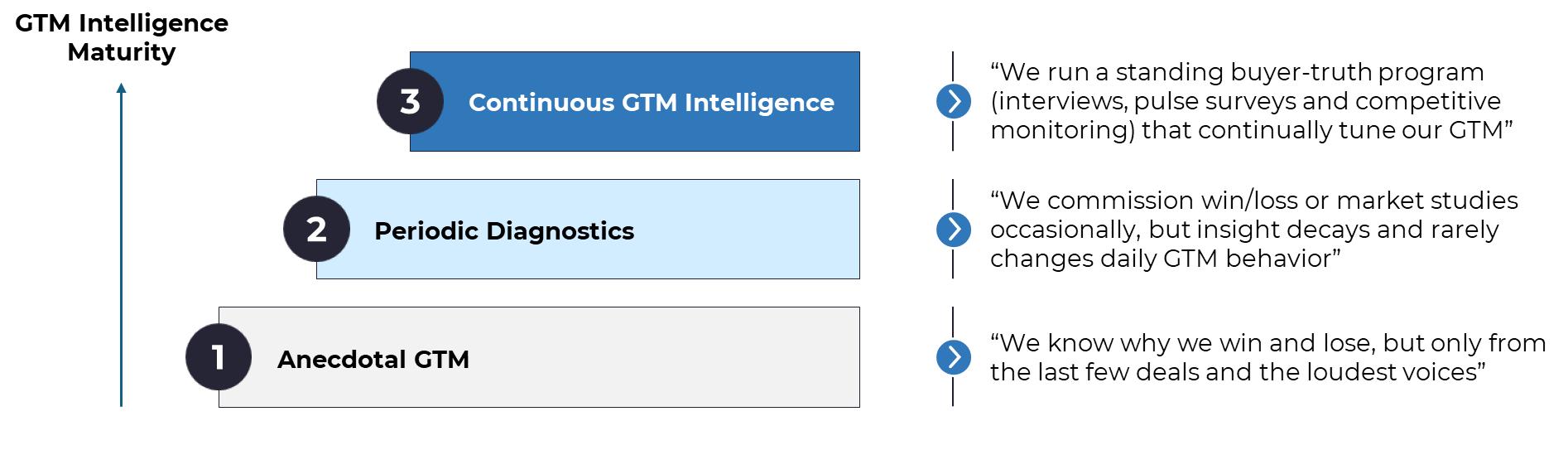
Organizations with a genuine GTM intelligence advantage look and feel different from those operating on internal assumptions.
They know, systematically, why they win and lose — not through the anecdotal filter of the sales team's most vocal voices, but through structured analysis across deal cycles and competitive scenarios. That knowledge flows directly into sales enablement, pricing decisions, and positioning work.
They understand the gap between what buyers say and what they do. The distance between a buyer's stated needs and their actual decision drivers is consistently underestimated, and closing it creates a compounding advantage in how commercial conversations are structured and how deals are framed.
And critically, they treat market intelligence as a continuous practice rather than a periodic exercise. Competitive dynamics shift. Buyer priorities evolve. The organizations that sustain their edge do so because they track it continuously, through win/loss pulse surveys, competitive monitoring, and quarterly strategic reviews, rather than relying on a diagnostic they commissioned two years ago.
With your board, buyer truth enables a conversation about conviction. Leadership wants to know whether the assumptions underpinning your growth plan are grounded in evidence or optimism. Being to point to externally validated insight fundamentally changes the quality of that dialogue.
On the ground, the conversation is harder. It requires submitting long-held assumptions to scrutiny. It means potentially accepting that your strongest segment may be more contested than you realize, or that the narrative your marketing team has refined over two years is not landing the way they believe. Uncomfortable, yes. But these are the conversations that precede every meaningful commercial improvement.
In a market where everyone claims to be customer-centric, the organizations that actually know what their customers think are rare. And right now, rare is exactly where the edge is.
Ready to Close the Gap Between Internal Assumptions and Buyer Reality?
Schedule a consultation with us to learn how we help operators and corporates build buyer-validated intelligence into their commercial decision making, and turn GTM clarity into measurable revenue performance.